Apprentice info
Pre-Apprentice Info
So you think you want to become a falconer?
You may have recently read about this ancient art in a book or periodical, learned about it through television or radio, perhaps a movie, or may have seen a trained hawk in action. Whatever the case, you were obviously impressed enough to want to learn more about the sport of falconry, and we appreciate your interest.
Few people who thrill at the brief, intense magic of a trained hawk in flight realize the intense demands placed upon one who aspires to be a falconer. Even fewer are willing to make the necessary sacrifices.
Time - Falconry is not an “overnight” achievement. Becoming a Master falconer takes at least seven years. Finishing your apprenticeship alone will take at least two years. Your hawk requires a significant amount of time every day, 365 days a year. A bird in training requires a substantial amount of time. Raptors, unlike a rifle or a bow, cannot be hung on the wall or forgotten until the next hunting trip. You might welcome this time commitment, but is your spouse okay with it? Your kids? Your career?
Effort and Ethics - Of all sports in North America, falconry is the only one that utilizes a trained wild creature. Falcons, hawks, eagles, and owls are all essential elements of our native wildlife ecosystems. The competent falconer follows sound conservation principles in the pursuit of the sport. Even though the federal government’s environmental assessment states that falconry has “no impact” on wild raptor populations, a careless, uninformed individual attempting to satisfy a passing fancy can do great harm to one or more birds and discredit the sport of falconry itself. Therefore, most falconers will require evidence of a serious, committed interest in falconry before they will agree to help anyone newly attracted to the sport. They just don’t have time for anything else. The ethics of practicing falconry are an important part of a falconer’s everyday life.
Permits - Because all raptors are protected by state, federal, and international law, all potential falconers must obtain the necessary permits and licenses before acquiring a bird or beginning to practice falconry. This can take time because it requires taking a written falconry exam, building the required facilities (called mews), having said facilities inspected by the state, obtaining the necessary equipment, and getting the signature of a current falconer willing to act as your sponsor. In some states, hunter education courses are required before someone can get a hunting license. You must be able to keep your paperwork straight, even in triplicate (3 copies!) if you are considering falconry.
Money - The cost of acquiring a hawk is only the first monetary requirement. But the purchase price of the bird is only the beginning expense - assuming one is available for purchase. In North America, most apprentice falconers will be required by their sponsor to trap their first bird from the wild. You must have money to spend. Food, shelter, equipment, veterinary costs, permits and fees, and travel are expenses you will incur. To keep your bird healthy, you must feed your raptor only fresh raw meat, preferably the same whole birds or mammals they would catch in the wild. Housing and equipment requirements are mandated by state and federal law. You will need money to buy the raw materials for the required housing and equipment, and you will need the skills to work with these materials. You will be inspected by the state authorities before you are permitted to acquire a hawk. Most falconers also spend considerable amounts of money on books as a source of vital information and enjoyment. You will have to pay permit and license fees as well. Travel adds up fast, too; obtaining a hawk, visiting other falconers, training and hunting can put thousands of miles literally on your car and empty wallets quickly.
Access to Land - You must have permission to enter adequate and convenient locations in which to fly a hawk or falcon, and there must be appropriate game available. Remember too that in some locations written permission of the property owner is required. The falcons require wide open expanses of land where they may be flown high over the falconer, while hawks and small accipiters can be hunted in smaller fields or farms. Gun hunting, roads, power lines, urban settings, and barbed wire fences may render an otherwise suitable location unusable because of the potential threats to the raptor and/or the falconer.
Personality
Are you sincerely interested in all aspects of wildlife and the outdoors?
How badly do you want to learn? Are you ready to start at the bottom… and stay there for two or more years?
Can you listen to and follow other people’s advice?
How much have you already read? A serious commitment to becoming a falconer is often evidenced by a ravenous appetite for books and online information.
Can you hunt? Not only do you know how, which is a challenge in itself, but are you emotionally prepared? Falconry is sharing your life with a creature that has evolved over millions of years as a predator. You will get to see predation up close and personal and must be prepared for that.
After investing all this time and effort, do you really understand that, at any moment of free flight, your bird can choose to simply fly away and never return? Or even become a part of the circle of life and be predated by another bird of prey? Falconry truly is the highest of the highs and lowest of the lows.
This is just a brief overview. It is not meant to be discouraging. It is meant to make you realize that the art and practice of falconry requires months and years of hard work punctuated by brief moments of exhilaration, excitement, and joy, as well as moments of sorrow, grief, stress, and frustration.
If you feel that you are serious about becoming a falconer, the next step is to contact the Kansas Department of Wildlife and Parks to request a falconry packet. Then you should join the Kansas Hawking Club and the North American Falconers Association.
Whether or not you become a falconer, we hope that you will continue to be interested in birds of prey, their conservation, and the ancient sport of falconry.
Here are some resources to get you started down the path to becoming an Apprentice!
Links:
Contact Sarah Navarro, the Falconry Administrator at the Kansas Department of Wildlife and Parks, to get your Apprentice Packet. This will contain all of the information needed to get you started. After you get your Apprentice Packet, contact Jake Thomas, the KHC Apprentice Coordinator, for more information on next steps. Pictured below are some of the essentials you must have to get started as a falconer.
Sarah Navarro
sarah.navarro@ks.gov
620-672-0797

Basic set of falconry equipment including: Hood, Leash, Jesses, Bells with Bewits, Anklets, and a Swivel

Mews and Weathering Yard
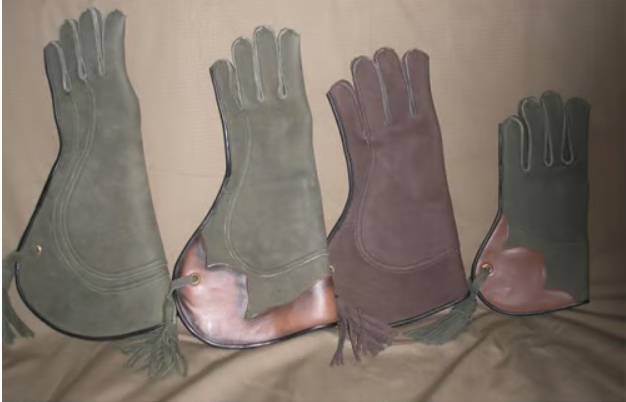
Gloves come in several different styles/sizes to fit flying different types of birds
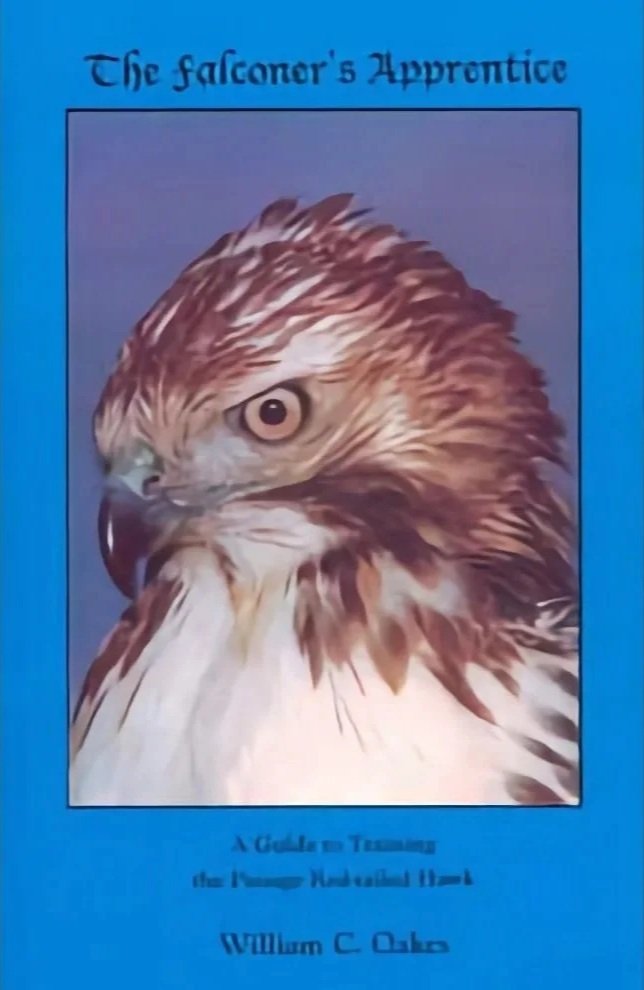
The Falconer’s Apprentice by William C. Oaks
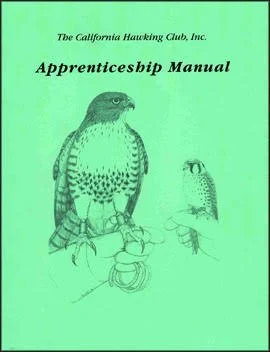
Apprenticeship Manual by The California Hawking Club
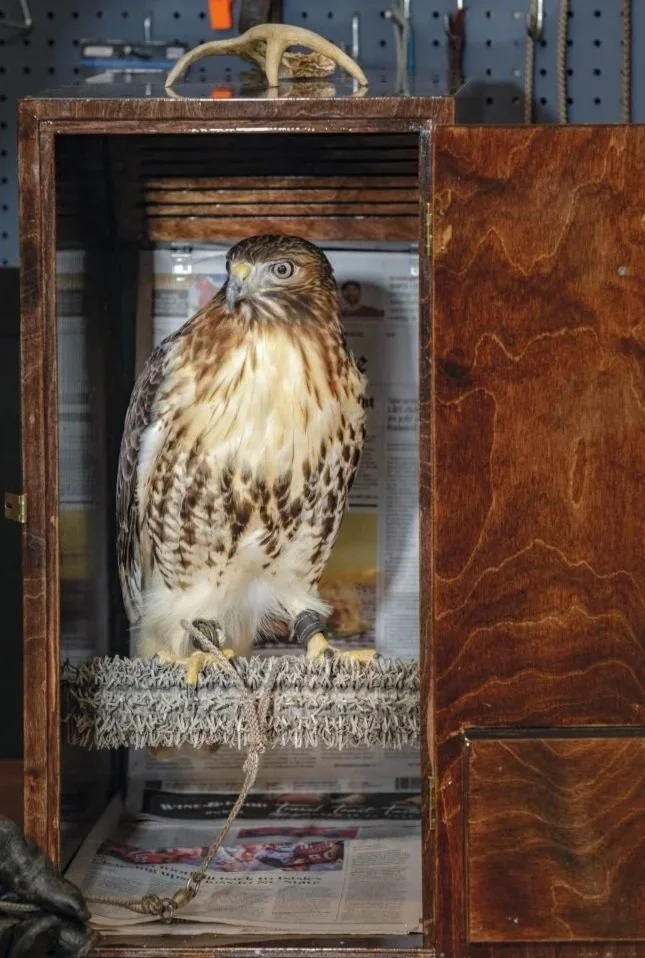
Giant Hood or Hawk Box/Crate. Can be made from a variety of materials
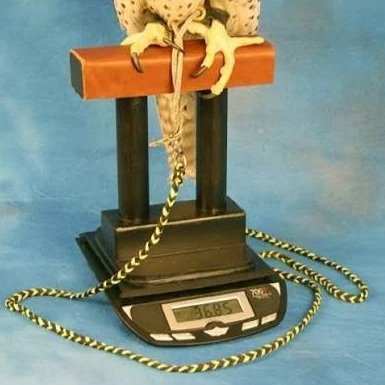
Scale for weighing birds daily
Other Books & Resources
Falconry Training Log Template
This template is fully customizable but gives even an experienced falconer a nice starting point for keeping a training and hunting log for their bird.
From the California Hawking Club, this gives a great comprehensive list of the best books to buy to get you started. They also include an extended list for the overachiever or raptor nerd and some DVD options as well.
This website contains lots of useful information on falconry equipment on a budget! There are tutorials for how to build mews, perches, giant hoods, and how to make some equipment.